
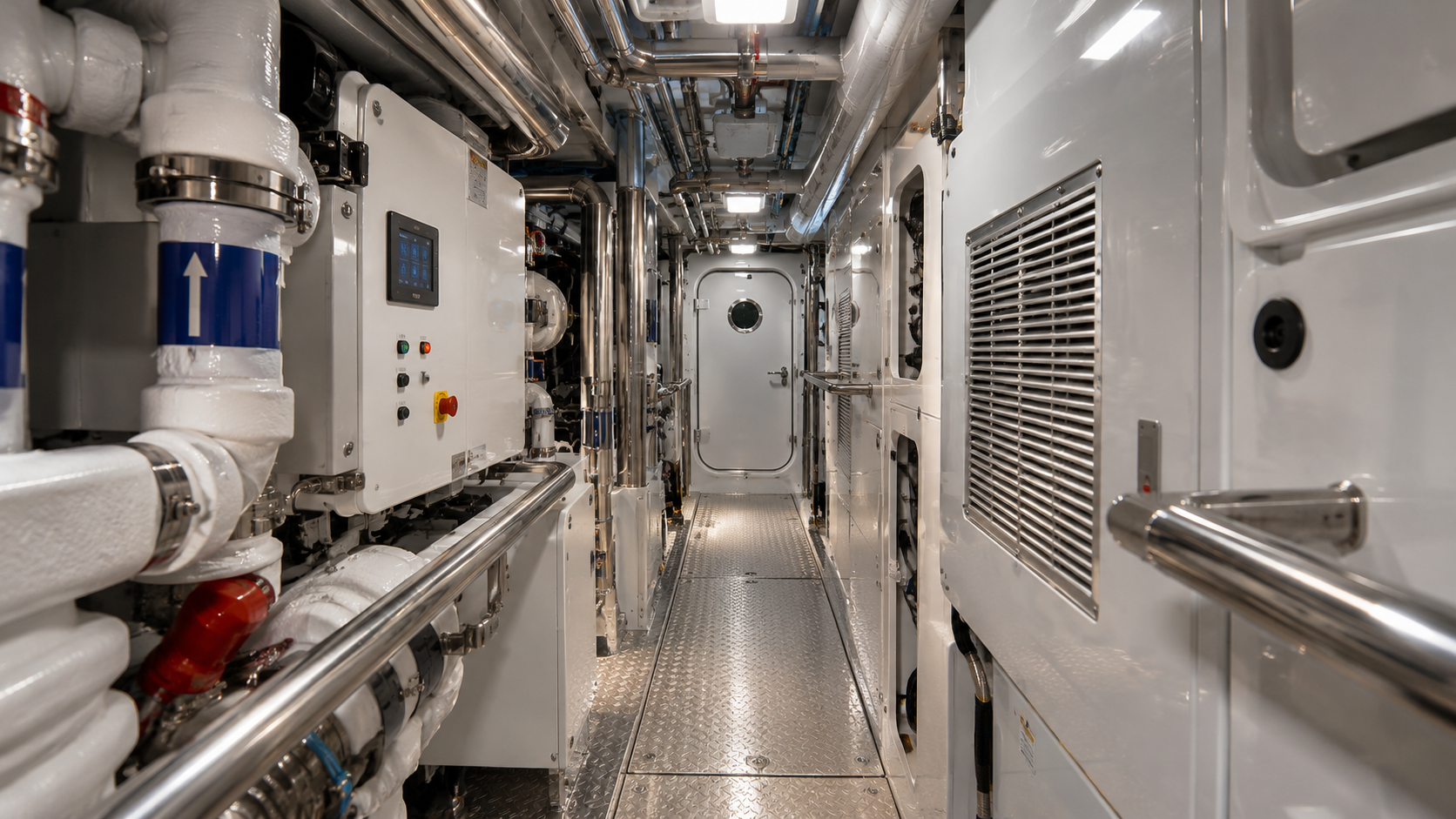
Most crew could name the enclosed spaces on their yacht without much thought, from the chain lockers forward to the tanks that only get opened during a yard period. What fewer can say with confidence is how each of those spaces behaves, what sits on the other side of its bulkheads, and where the rescue tripod is stowed if something goes wrong on the way in. That gap between knowing a space exists and genuinely understanding it is exactly where the International Maritime Organization has now focused its attention, and it makes enclosed space entry on yachts a subject worth revisiting this season.
In June 2025 the IMO’s Maritime Safety Committee adopted Resolution MSC.581(110), the Revised Recommendations for Entering Enclosed Spaces Aboard Ships, which replace the guidance the industry had worked to since 2011. The reason is sobering. InterManager estimated in 2025 that around 350 seafarers and shore workers have died from asphyxiation in shipboard enclosed spaces since 1996, with 70 of those deaths coming from 43 accidents since 2022 alone, as summarised by DNV. Those figures come largely from commercial shipping, yet the physics of a rusting chain locker or a sealed sewage tank is identical on a 70 metre yacht.
The recommendations apply to all ship types, and the IMO makes a point that should land with anyone working on yachts. On vessels where enclosed space entry is infrequent, the dangers can be less apparent, so greater vigilance is needed. A crew that opens a void space twice a year has far less muscle memory than a bulk carrier crew who do it every voyage.
What the revised IMO guidance changes
The headline addition is the Enclosed Space Register, a ship-specific record of every enclosed space onboard, kept both on the vessel and ashore as part of the safety management system. It is far more than a list of names. The IMO expects it to capture the physical layout of each space and its access and escape points, the connected and adjacent spaces around it, physical hazards such as vertical ladders and poor lighting, the ventilation equipment available and where it is stored, roughly how long ventilation takes to make the space safe, the means of testing the atmosphere and the rescue equipment the space would demand. The register then becomes the foundation for the risk assessment and for a ship-specific enclosed space emergency response plan, which the IMO suggests reviewing after every drill.
The definitions have sharpened too. A connected space now includes anywhere linked to a hazardous space by a door, and the guidance is explicit that a manual door, even a watertight one, counts, because nobody outside can tell whether it is properly sealed. It also introduces the idea of a trapped hazardous atmosphere, where gas lingers in a connected compartment long after the source has been cleared. Clearer roles follow from this, with the competent person who assesses the atmosphere, the responsible person at management level who authorises entry, and the attendant who keeps watch from the entrance and raises the alarm.
In practice, single-person entry is no longer permitted. Personal gas detectors carried by those entering should now monitor carbon dioxide alongside oxygen, flammable gases and toxic gases such as carbon monoxide, and the safe entry readings include a specific carbon dioxide limit of less than 0.5% by volume. Entry permits must have a validity set by the risk assessment and capped at eight hours, and leaving a space unattended voids the permit altogether. One line in the guidance deserves particular attention on yachts, where the owner’s programme rarely waits for anyone: the IMO identifies undue time pressure, whether spoken or simply implied, as a causal factor in many enclosed space accidents.
What enclosed space entry on yachts really involves
Much of the resolution is written with cargo ships in mind, and a yacht crew could be forgiven for skimming the sections on bulk cargoes and fumigation. The underlying principles transfer directly, though. The IMO defines an enclosed space as one with limited openings, inadequate ventilation or no design for continuous occupancy. On a typical superyacht that brings in the chain lockers and forward voids, cofferdams, fuel and fresh water tanks, grey and black water holding tanks, the compartments around sewage treatment plants, and any space protected by a fixed gas fire suppression system once that system has been discharged.
The guidance gives a striking example on chain lockers. Experimental data included in the resolution shows how steadily rusting anchor chain draws oxygen out of a closed locker, with the process running considerably faster in warm conditions. For a yacht that spends its summer in the Mediterranean and its winter in the Caribbean, that is a practical consideration. The resolution also asks companies to reassess a space whenever its contents change, using the example of treated sewage or grey water stored temporarily in a ballast tank. Yachts that reconfigure tank use during a refit, or that run tanks differently between charter and owner trips, will recognise how easily a register can fall behind what is actually in the tanks.
It is also worth remembering that the drill requirement itself is longstanding. SOLAS regulation III/19.3.6 already requires enclosed space entry and rescue drills, and the revised guidance asks that these are run against the spaces in the register, using the equipment the crew would rely on for real and covering different aspects of operations each time.
Is your enclosed space information really vessel-specific?
Updating the SMS to reflect MSC.581(110) is the straightforward part, and most management companies will already have revised their procedures and permit templates. The harder question is whether the information behind those procedures describes this particular yacht. A generic enclosed space procedure can be perfectly compliant on paper while saying nothing useful about where the forward void connects to the bow thruster room, or which tank vent runs past the crew mess.
This is where the register exposes the quality of a vessel’s underlying documentation. Almost everything the IMO asks the register to hold depends on accurate, as-built knowledge of the vessel, and on many yachts that knowledge is scattered across shipyard drawings written for builders, OEM manuals for individual pieces of equipment and the memory of a chief engineer who may rotate off next month. We explored that difference in Shipyard Information vs Operator Information, and enclosed spaces show it at its sharpest, because an attendant or rescue team has no time to unfold an A0 drawing at a tank hatch.
Accessibility matters just as much. The IMO’s example emergency response plan has the crew consulting the register or the entry permit during a rescue for the particulars of the space in question. That only works if the information sits where people can reach it quickly and in a form they can read under pressure, which is why a clear space diagram or a laminated drawing at the point of use is worth more than a perfect register filed in the ship’s office. Our earlier piece on laminated drawings and pocketbooks looks at that principle in more detail.
Then there is understanding, which no document can guarantee by itself. The resolution asks that all crew are trained, as appropriate, in enclosed space safety, including familiarisation with the onboard procedures, and it is candid about the instinct that kills would-be rescuers. When a colleague collapses inside a tank, the urge to go straight in is immense, and many enclosed space accidents have been made worse by well-meaning rescue attempts without the right equipment. Resisting that urge depends on crew having absorbed the plan long before the alarm sounds, which brings us back to the challenge of crew rotation covered in Rotation Without Risk. A newly joined deckhand needs to know as much about the yacht’s enclosed spaces as someone who has been onboard for three seasons.
Refit season and the contractors onboard
For many yachts the riskiest weeks for enclosed space entry are spent alongside rather than at sea. Winter yard periods bring tank inspections and coating work, often carried out by contractors who have never seen the vessel before and while the crew are stretched across several jobs at once. The revised guidance speaks directly to this. It asks that shore personnel are given information on the enclosed space hazards they may meet onboard, and it asks companies to set criteria for managing simultaneous operations when one of them involves an entry.
It also recommends a simple schematic plan of the vessel at the gangway or other access points, marking which spaces are safe to enter and which are not, time-stamped and kept up to date by the responsible person. The IMO notes that this can be especially useful in dry dock or ship repair, where large numbers of shore workers are onboard. Few yachts arrive at the yard with anything like that ready to print, yet the information needed to produce it is the same information that should already be in the register and the vessel’s technical documentation.
The attendant role deserves a fresh look in this context too. During a busy refit it can be tempting to hand the job to whoever is free, and the guidance is clear that the attendant should be properly trained within the SMS and remain in constant attendance at the entrance. A door left open for ventilation can easily be mistaken for a sign that a space is safe, so the IMO suggests posting an attendant or a physical barrier at the opening and including open spaces in the watch handover.
Turning the guidance into something crew can use
The revised recommendations give the yacht sector a good reason to ask a question it rarely puts to itself. If a crew member had to lead a rescue from the black water tank tonight, would they find everything they needed about that space quickly, and would they trust it?
At Sentini Marine, much of our work involves producing exactly the vessel-specific information an Enclosed Space Register depends on. Our Technical Operating Manuals and SOLAS manuals document a yacht’s systems and spaces as built, and laminated drawings and pocketbooks put that information where it is needed. Fathom then helps crew absorb it, with short, regular knowledge checks and NFC or QR based familiarisation that tests whether people know where rescue and safety equipment is located, so senior officers can see where understanding is strong and where a drill would add most value.
A useful starting point is to walk your own register against the yacht with your chief engineer and chief officer, space by space, and see whether it still reflects the yacht as she operates today. If you would like to talk through how documentation and familiarisation could support that work, get in touch with our team.
Leave a Reply