
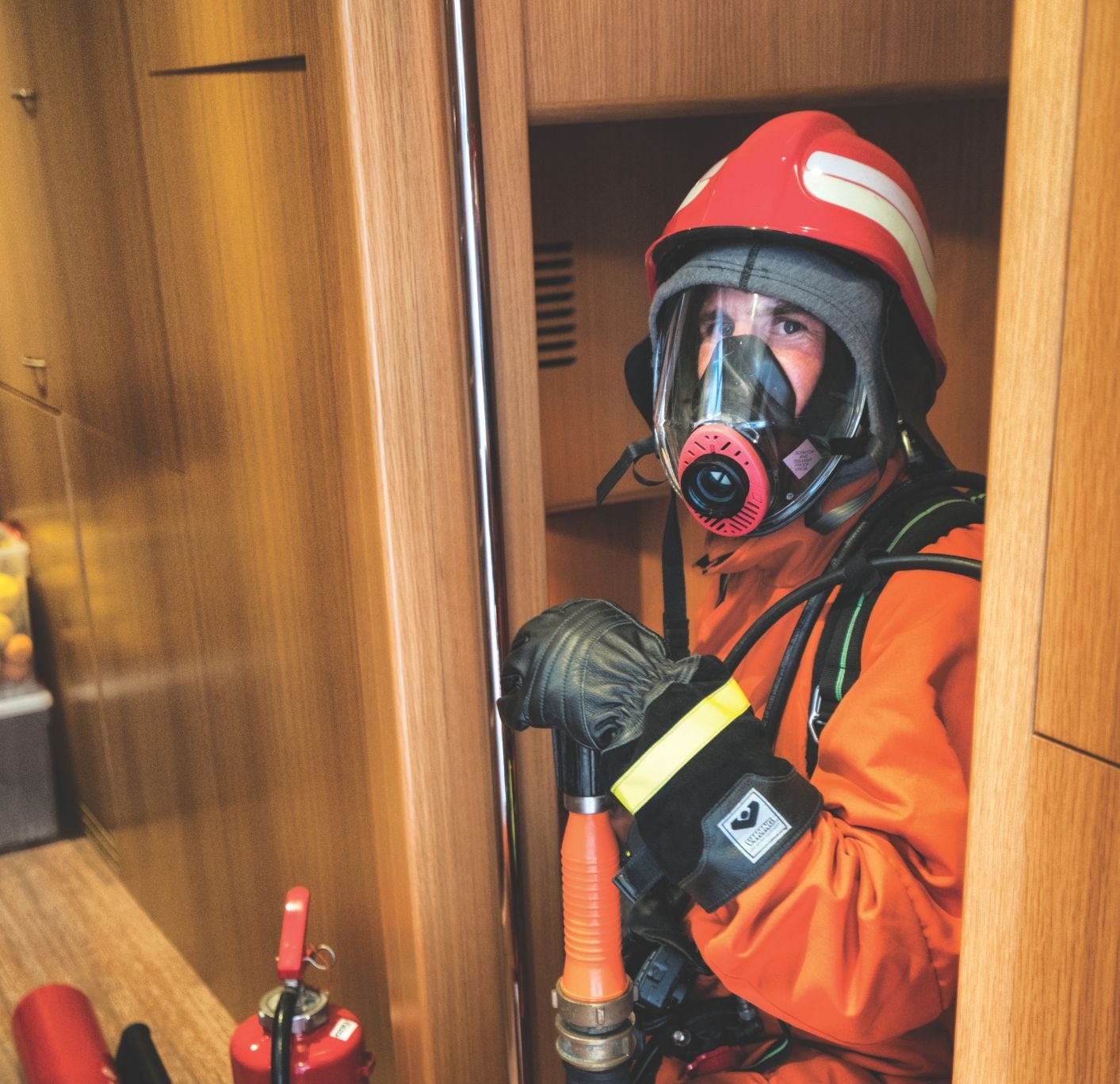
When lithium-ion systems work as designed, they’re quiet, clean and efficient powerhouses. When they don’t, the consequences can be catastrophic.
In April 2024, the 24.9m catamaran Flagship was destroyed by an explosion and fire while alongside in a Miami shipyard. The yacht was uncrewed at the time, but the incident is a clear warning for anyone operating modern yachts with high-energy battery systems. (NTSB)
The recent NTSB investigation into the fire highlights a familiar story: a technical issue with a battery management system (BMS), temporary workarounds, and a lack of robust controls around a critical risk. The good news for captains, engineers and owners’ offices is that many of the lessons are practical and actionable.
This article summarises what the NTSB found, then translates those findings into three layers of control you can put in place onboard:
- Location familiarisation
- Clear emergency actions
- Battery SOP knowledge checks: supported by FATHOM
What actually happened on Flagship?
The NTSB’s investigation details the following key points: (NTSB Investigation)
- Flagship was fitted with multiple lithium-ion battery banks, three 48-volt systems and one 24-volt system.
- From early in the vessel’s life there were known issues with the battery management systems (BMS) on both the 24-volt and 48-volt banks. The BMSs were not operating correctly and were not reliably managing charge levels.
- To keep the vessel powered and speed up charging, a workaround was developed: wiring was installed to bypass each BMS so the batteries could be charged directly from external chargers.
- With the BMSs bypassed or inoperable, the system no longer had its designed protections against over- or under-charging, and charge state was not being automatically controlled.
- On 28 April 2024, an explosion occurred in the space where the 24-volt lithium-ion battery bank was located, followed by a fire that ultimately destroyed the vessel.
- The NTSB concluded that the probable cause of the fire was the thermal runaway and explosion of a cell within the 24-volt lithium-ion battery bank, and that inoperable battery management systems were a key causal factor.
In other words: a high-energy battery installation was operating without its safety “brain”, and everyone was relying on manual workarounds.
No one set out to take shortcuts, but a combination of time pressure, commissioning challenges and a lack of structured controls created a serious vulnerability.
Why the BMS is non-negotiable
For lithium-ion banks, the BMS is not a “nice-to-have”. It is a primary safety system.
At a simple level, the BMS:
- Monitors individual cell voltage and temperature
- Balances cells so no single cell is pushed out of limits
- Disconnects charging or load in unsafe conditions (over-charge, deep discharge, over-temperature, internal faults)
If the BMS is inoperable or bypassed:
- Cells can drift apart in state of charge and temperature
- Localised damage (for example from deep discharge or over-charge) may not be detected
- There is no automatic cut-off if something goes wrong
Thermal runaway can then start in a single stressed cell and propagate through the bank – exactly what the NTSB determined on Flagship.
Most yachts now carry a mix of lithium systems: house banks, thrusters, toys, bikes, dive kit, even crew devices. You won’t always control the design, but you can control how well your crew understand:
- Where these systems are
- What to do when something goes wrong
- What “workarounds” are absolutely off-limits
That’s where structured familiarisation and knowledge checking, including through FATHOM, comes in.
1. Location familiarisation: “Show me where the risk lies”

On Flagship, CCTV footage showed the initial explosion coming from the space where the 24-volt lithium-ion bank was located, below the deck.
Ask yourself, very practically:
- Do all officers know the exact location of every high-energy battery bank on board?
- Could your junior crew point out those spaces on a general arrangement plan and on the real vessel, without hesitation?
- Are those spaces clearly marked as containing lithium-ion systems, including on emergency plans and muster documentation?
Controls to consider
- Add “battery spaces” to your formal familiarisation routes for all new crew, not just engineers.
- Mark lithium-ion compartments on printed and digital GAs, fire plans and mustering boards.
- Define who is authorised to enter and work in those spaces, and under what conditions (PPE, electrical isolation, hot work restrictions, etc.).
- Ensure yard personnel and contractors are briefed on these spaces and the controls in place during yard periods.
How FATHOM can help
FATHOM is designed to connect digital knowledge with physical locations. Using NFC/QR tags and vessel-specific questions, you can:
- Link quiz content directly to access hatches or compartments housing lithium-ion systems.
- Test whether crew know precisely where the 24-volt bank is, not just that “we have batteries somewhere aft”.
- Track which crew have physically visited and acknowledged each critical location.
It turns “there’s probably a bank under that deck” into “I know exactly where it is, how to access it, and what’s nearby”.
2. Emergency actions: when a battery doesn’t behave
The Flagship fire reinforces a simple truth: once thermal runaway starts, your window to act safely is short. The best time to prepare is long before you see smoke.
Your procedures will (and should) follow OEM guidance, flag and class rules. But at a practical, crew level, everyone should be clear on three questions:
- What are the early warning signs?
- Unusual smells, hissing, popping sounds
- Localised heating of cabling or casings
- Discoloured, swollen or leaking cells
- Unusual smells, hissing, popping sounds
- What are the first three actions if we suspect a lithium-ion issue? For example:
- Raise the alarm and inform the bridge/engineer of the exact location
- Isolate charging sources and relevant breakers, if safe to do so
- Clear non-essential personnel from the area and control access
- Raise the alarm and inform the bridge/engineer of the exact location
- How do our fire tactics change for a lithium-ion space?
- Cooling boundaries and exposure protection
- Avoiding opening a tightly closed space until you understand conditions
- Using appropriate extinguishing media as per equipment and OEM guidance
- Cooling boundaries and exposure protection
These are not theoretical questions. They should be drilled.
How FATHOM can help
FATHOM is built to make emergency procedures memorable and testable, not just paragraphs in a manual.
- Scenario-based questions: “You see smoke coming from the 24-volt battery compartment hatch. List your first three actions.”
- Role-specific tests:
- Bridge: communication and decision-making steps
- Engineering: isolation, assessment, interaction with OEM guidance
- Deck: cordons, support, mustering impact
- Bridge: communication and decision-making steps
- Regular refreshers, not one-off familiarisation: using weekly or monthly lithium-focused questions to keep the risk front-of-mind.
Over time, you build a data-backed picture of who really understands the plan and where you need to focus drills.
3. Battery SOPs and “no-go” workarounds
The Flagship report doesn’t just describe a technical failure, it describes a process failure: problems with the BMS were not resolved during construction, and temporary bypasses became normal practice to keep the boat moving.
Every yacht is vulnerable to the same pattern, especially in yard periods and under time pressure:
- A system doesn’t behave as expected.
- A “temporary” workaround is suggested.
- Documentation and risk assessment lag behind reality.
For lithium-ion systems, that can be the difference between a safe workaround and an unacceptable transfer of risk.
Controls to consider
- Clear SOPs for lithium-ion banks, covering:
- Who can approve changes to charging arrangements or protective devices
- How defects in BMS or protection systems are escalated (and to whom)
- What temporary measures are explicitly prohibited (e.g. bypassing BMS without OEM and class involvement)
- Who can approve changes to charging arrangements or protective devices
- Yard & contractor interface procedures that require:
- Documented risk assessments for any proposed changes to battery installations
- Written confirmation when any protective function is disabled, with time limits and compensating measures
- Documented risk assessments for any proposed changes to battery installations
- Pre-departure and post-yard checklists that explicitly ask:
- “Are any battery protection systems bypassed, inhibited or operating in degraded mode?”
- “Are any battery protection systems bypassed, inhibited or operating in degraded mode?”
Again, the common failure mode is not having procedures, it’s people not knowing and using them.
How FATHOM can help
FATHOM’s core purpose is to turn dense SOPs into bite-sized, testable knowledge:
- Break your lithium-ion SOPs into short, vessel-specific question sets.
- Target questions by rank, more technical depth for engineers, decision-making for captains and owners’ reps.
- Use FATHOM’s reporting to prove continuous safety knowledge growth, in line with ISM 1.2.2.3’s requirement for ongoing improvement, not just annual checks.
Instead of assuming “everyone knows we never bypass the BMS”, you can see, in black and white, who has understood and retained that message.
What we can learn
For most yachts, lithium-ion technology is now part of everyday operations: on deck, in the engine room and in the crew’s pockets. The Flagship case is a reminder that:
- High-energy battery systems demand the same level of procedural control as fuel, high-pressure hydraulics or cargo operations.
- A non-functional or bypassed BMS is not just a “technical snag,” it’s a change in risk profile that must be managed at captain/management/owner level.
- The weakest link is often not equipment, but familiarity: do your people know where the risk lives, what to do, and what they must never do?
That last piece, human knowledge and behaviour, is exactly where FATHOM is designed to help.
Use the lithium-ion fire module inside FATHOM
If you’d like to pressure-test your current controls around fire safety, we’ve created a module that can be deployed directly inside FATHOM as a question set and familiarisation route. Taking the lessons from Flagship into practical, trackable improvements on your own vessel.
Leave a Reply