
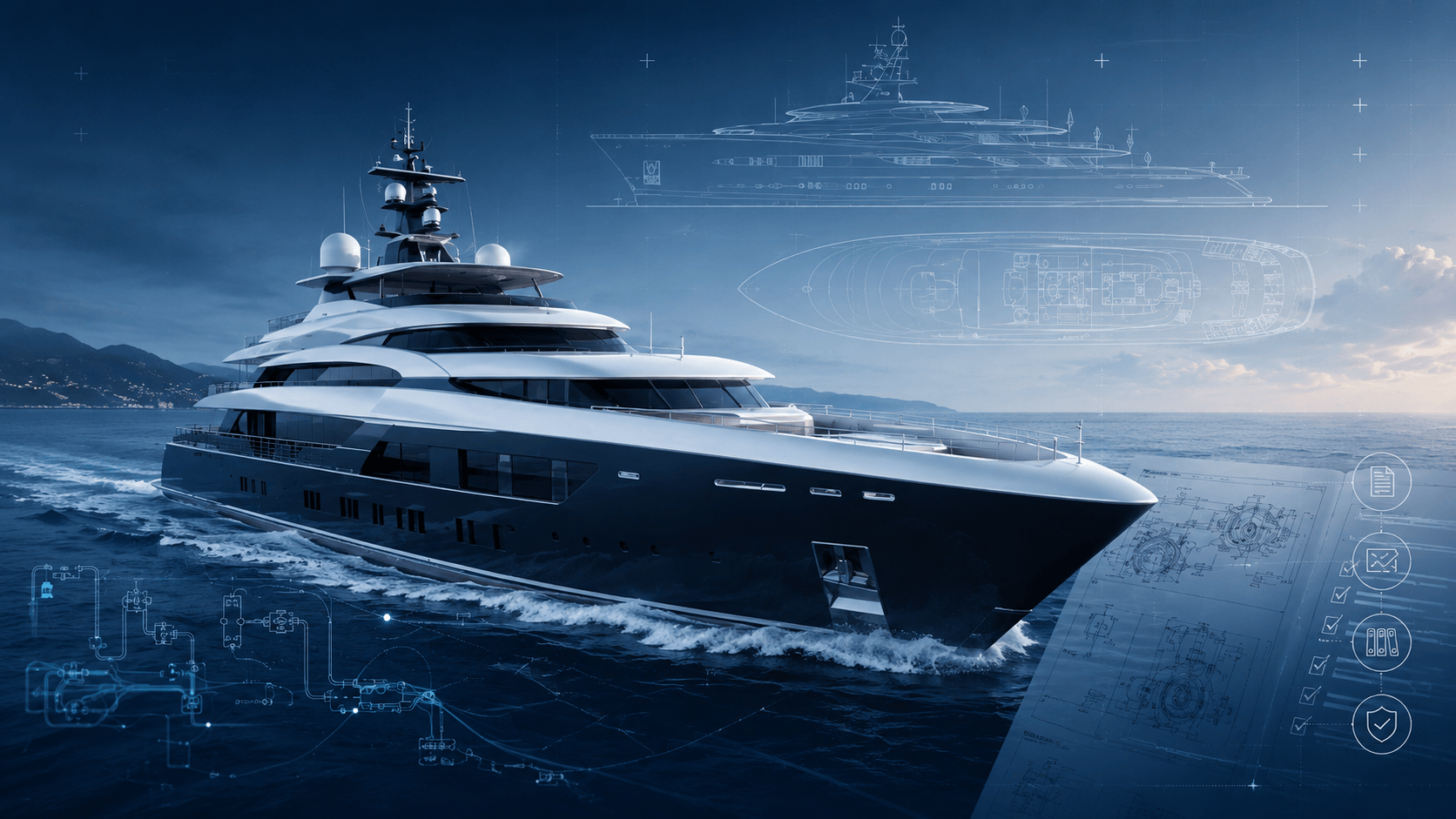
Commercial shipping and superyachting operate in very different environments.
One is built around the movement of cargo and passengers at scale. The other must combine technical performance with privacy, luxury, flexibility and an exceptional owner experience.
Their vessels have different purposes. Their operating profiles are different. Their cultures are different.
However, both depend on the same fundamental requirement: crew must be able to operate increasingly complex vessels safely, consistently and confidently.
That depends on more than the quality of the engineering onboard. It also depends on the quality of the information supporting it.
This is one area where commercial shipping still has something valuable to teach yachting.
The lesson is not that every commercial practice should be transferred directly onto a superyacht. Nor is it that yachting lacks professionalism or regulation. The current Red Ensign Group Yacht Code, for example, prescribes safety and pollution prevention standards appropriate to different sizes and types of yacht.
The lesson is simpler: operational information should be treated as part of the vessel’s working infrastructure, not simply as a collection of documents that must be delivered.
Commercial shipping treats information as an operational control
Commercial shipping has developed within a highly structured international safety framework.
The International Safety Management Code provides a global standard for the safe management and operation of ships, while SOLAS sets minimum requirements for their construction, equipment and operation.
Within that environment, procedures, records, manuals and operating instructions are not viewed separately from the operation of the vessel. They are part of the system through which safe and repeatable performance is achieved.
This does not mean that every commercial ship has perfect documentation. Anyone with experience at sea will know that manuals can still be poorly written, difficult to navigate or insufficiently maintained.
The difference is the underlying expectation.
Information is generally expected to be structured. Responsibilities are defined. Procedures are controlled. Revisions are recorded. Operational knowledge is captured in a form that can be reviewed, communicated and applied by different people over time.
That structure matters because vessels do not operate through individual expertise alone.
They operate through the combined knowledge of the crew and experience gained from a wider fleet perspective, the information available to them and the systems used to keep both current.
Yachting often starts from a different point
A new superyacht may be delivered with an enormous volume of information.
There may be shipyard drawings, equipment manuals, commissioning records, certificates, warranty documents, safety documentation and files produced by dozens or even hundreds of suppliers.
The issue is rarely a complete absence of information.
The issue is whether that information has been brought together in a way that supports the people operating the yacht.
OEM manuals explain individual pieces of equipment, but they do not necessarily explain how those components interact within the vessel’s wider systems.
Shipyard drawings may contain highly detailed design and construction information, but they were often created primarily for those building or installing the system rather than those who will operate it at sea.
Crew notes may provide useful practical context, but their quality, structure and longevity can vary. Important knowledge may remain in personal notebooks, informal handover conversations or the memory of a long serving engineer.
A technically complete delivery package can therefore still leave the crew without a clear, dependable and vessel wide operating reference.
Sentini was formed after its founders brought experience from commercial shipping into yachting and recognised a marked difference in how technical and safety information was being produced and communicated. That experience shaped the company’s focus on accurate information, usable documentation and safer vessel operation.
Lesson one: write for the operator, not only the builder
Design information and operational information perform different jobs.
A shipyard needs documents that support design, installation, commissioning and regulatory approval. Engineers need detailed specifications. Suppliers need information about interfaces and connections.
Crew need to know how the finished vessel actually works.
They need to understand:
- What the system does
- How it is configured onboard
- How it should be started, operated and shut down
- How it interacts with other systems
- What hazards and limitations apply
- What to check when something does not behave as expected
- Where the relevant equipment is located
- What actions are required in abnormal or emergency conditions
These needs cannot always be met by handing over the information used during construction.
Operator focused documentation translates technical detail into the context of the completed yacht. It removes redundant build information, retains the detail required for safe operation and presents it in a structure that reflects how crew search for and use knowledge onboard.
This is the purpose of a vessel specific Technical Operations Manual.
Rather than replacing OEM information, a Technical Operations Manual connects it. It provides a coherent view of the yacht and directs users towards the appropriate level of detail when further technical information is needed.
Lesson two: consistency reduces uncertainty
Commercial shipping documentation benefits from repeatable structures and conventions.
When similar information is presented in similar ways, users spend less time working out how a document is organised and more time understanding the task in front of them.
That principle is particularly relevant on superyachts, where crew turnover can place considerable pressure on knowledge continuity.
A new engineer may arrive with extensive technical experience but no knowledge of that particular vessel. A relief officer may have limited time to understand its arrangements. A junior crew member may need to locate safety information quickly without knowing which supplier produced the original document.
Consistent documentation helps reduce this dependence on prior vessel knowledge.
System descriptions can follow the same sequence. Operating procedures can use the same terminology. Warnings can be presented clearly. Drawings can use recognisable symbols and labels. Cross references can guide the reader to associated systems.
Consistency does not make a vessel less individual. It makes the information supporting that vessel easier to understand.
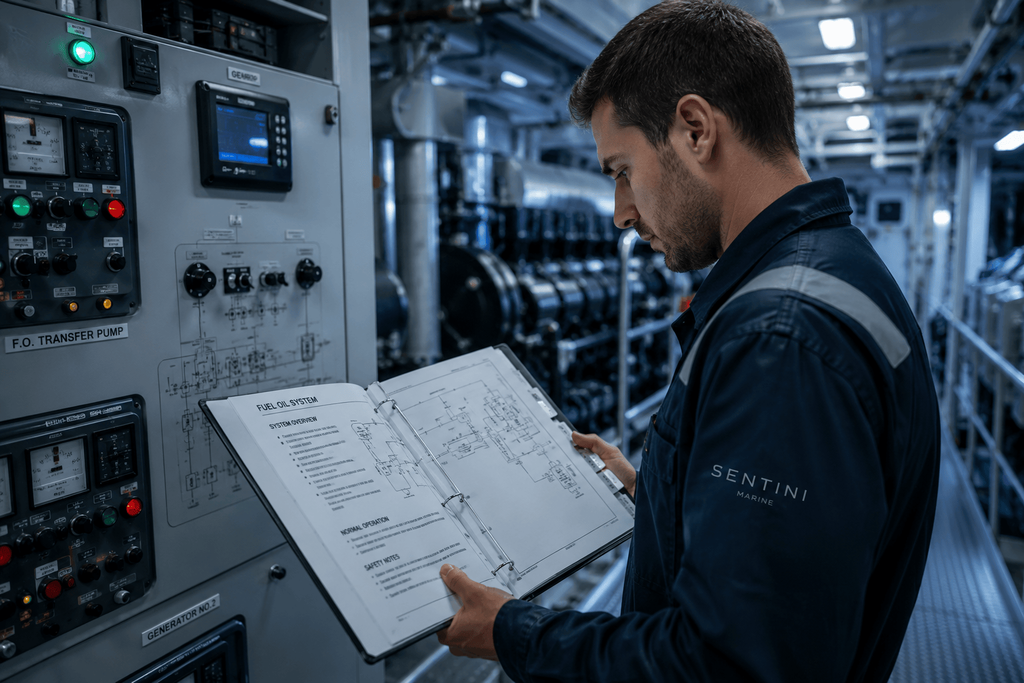
Lesson three: documentation must reflect the vessel as built
Information loses operational value when it no longer reflects reality.
A drawing may have been correct during an earlier stage of the build but became inaccurate after a pipe route, valve, panel or piece of equipment was changed. A manual may describe a proposed arrangement that was modified during commissioning. A procedure may remain unchanged after a refit altered the system.
Even a small discrepancy can create uncertainty.
Crew may begin to question whether other information can be trusted. Troubleshooting can take longer. Maintenance planning becomes more difficult. Discussions with shipyards and suppliers may be based on conflicting records.
Commercial shipping’s emphasis on document control provides an important lesson here: verification and revision are not administrative tasks. They are part of maintaining the reliability of the vessel’s operational knowledge.
Documentation should be verified against the completed installation wherever possible. It should also be capable of being updated as the yacht changes.
Sentini’s documentation service includes bespoke Technical Operations Manuals, SOLAS manuals, laminated drawings and pocketbooks, together with ongoing support to maintain manuals during the vessel’s operational life.
The objective is not to create a perfect document at one fixed moment. It is to establish a dependable source of information that can continue to evolve with the yacht.
Lesson four: usability is a safety consideration
The presence of information onboard does not guarantee that it can be used effectively.
In routine operations, poor usability creates delay and frustration. Under pressure, it can become a safety issue.
The IMO’s fire safety requirements recognise the relationship between information and operational readiness by addressing the provision of instructions, onboard training and drills for those responsible for emergency procedures.
The same principle applies more broadly across vessel operations.
- Can the correct information be found quickly?
- Is it written in language appropriate for its user?
- Are drawings legible and relevant?
- Are warnings visible?
- Can a crew member move logically from a system overview to an operating procedure?
- Is the information available in a format suited to where it will be used?
A complete documentation suite may therefore include more than a large central manual.
A detailed Technical Operations Manual can provide the vessel wide reference. Laminated drawings can support work in technical spaces. Pocketbooks can give crew rapid access to essential diagrams. Digital tools can improve search and availability. Familiarisation platforms can help confirm that important information has been understood rather than merely supplied.
Sentini’s approach reflects this by combining formal technical documentation with practical formats and familiarisation tools intended to make vessel specific information easier to access and apply.
The most effective format is not automatically the most sophisticated. It is the format that helps the right person retrieve and understand the right information at the right time.
Lesson five: documentation standards influence operating standards
Documentation does not operate a yacht. People do.
However, the quality of the information available influences the decisions those people are able to make.
Clear instructions support consistent procedures. Accurate drawings support effective fault finding. Verified system information improves maintenance planning. Accessible safety information strengthens familiarisation. Controlled revisions reduce the risk of people relying on outdated arrangements.
Poor information creates the opposite conditions.
Crew compensate by asking the person who has been onboard longest. They create unofficial notes. They rely on memory. They develop workarounds. Knowledge becomes concentrated in individuals rather than retained by the vessel.
This may function effectively while the same experienced team remains onboard. The weakness appears when someone leaves, the yacht changes ownership, a refit begins or an unfamiliar fault occurs.
Documentation standards therefore shape more than the quality of the handover package. Over time, they influence how knowledge is shared, how consistently tasks are performed and how confidently the vessel can respond to change.
What yachting should borrow, and what it should not
The answer is not to make every superyacht operate like a container vessel, tanker or passenger ship.
Yachting must remain responsive to owners. Its crews frequently perform broader roles. Its operational schedules can change quickly. Its systems are often highly customised. Documentation must reflect that reality.
A commercial shipping approach should therefore be adapted, not copied.
Yachting can borrow the discipline:
- A clear structure for vessel wide operational information
- Defined and consistent terminology
- Operator focused system descriptions and procedures
- Verified as built drawings
- Visible warnings and hazard information
- Effective document control
- Planned revision following modifications and refits
- Formats designed around real onboard use
- Better retention of knowledge when crew change
At the same time, it should preserve the practicality, flexibility and vessel specific understanding that good yacht crews already bring to their work.
The objective is not more paperwork.
It is better information.
A stronger information foundation for safer yachts
Modern superyachts are sophisticated assets containing complex engineering, control, communication and safety systems.
The standard of operational information should reflect that sophistication.
Commercial shipping’s most valuable lesson is that documentation should not be treated as the final administrative stage of a build or refit. It should be treated as an active part of safe vessel operation.
That means creating information for the crew who will use it, verifying it against the yacht they will operate, presenting it consistently and maintaining it as the vessel changes.
Sentini Marine was established to bring this commercial maritime discipline into yachting without losing sight of how superyachts actually operate. Its aim is not simply to deliver manuals, but to connect accurate vessel knowledge with safer, clearer and more efficient operation.
Because when the standard of information onboard improves, the standard of operation has the opportunity to improve with it.
Is your vessel’s documentation ready for operation?
Sentini Marine creates bespoke, operator focused Technical Operations Manuals, SOLAS manuals, verified drawings and practical supporting information for new builds, operational yachts and refit projects.
To discuss the quality, usability or condition of your yacht’s technical documentation, contact the Sentini Marine team.
Leave a Reply