
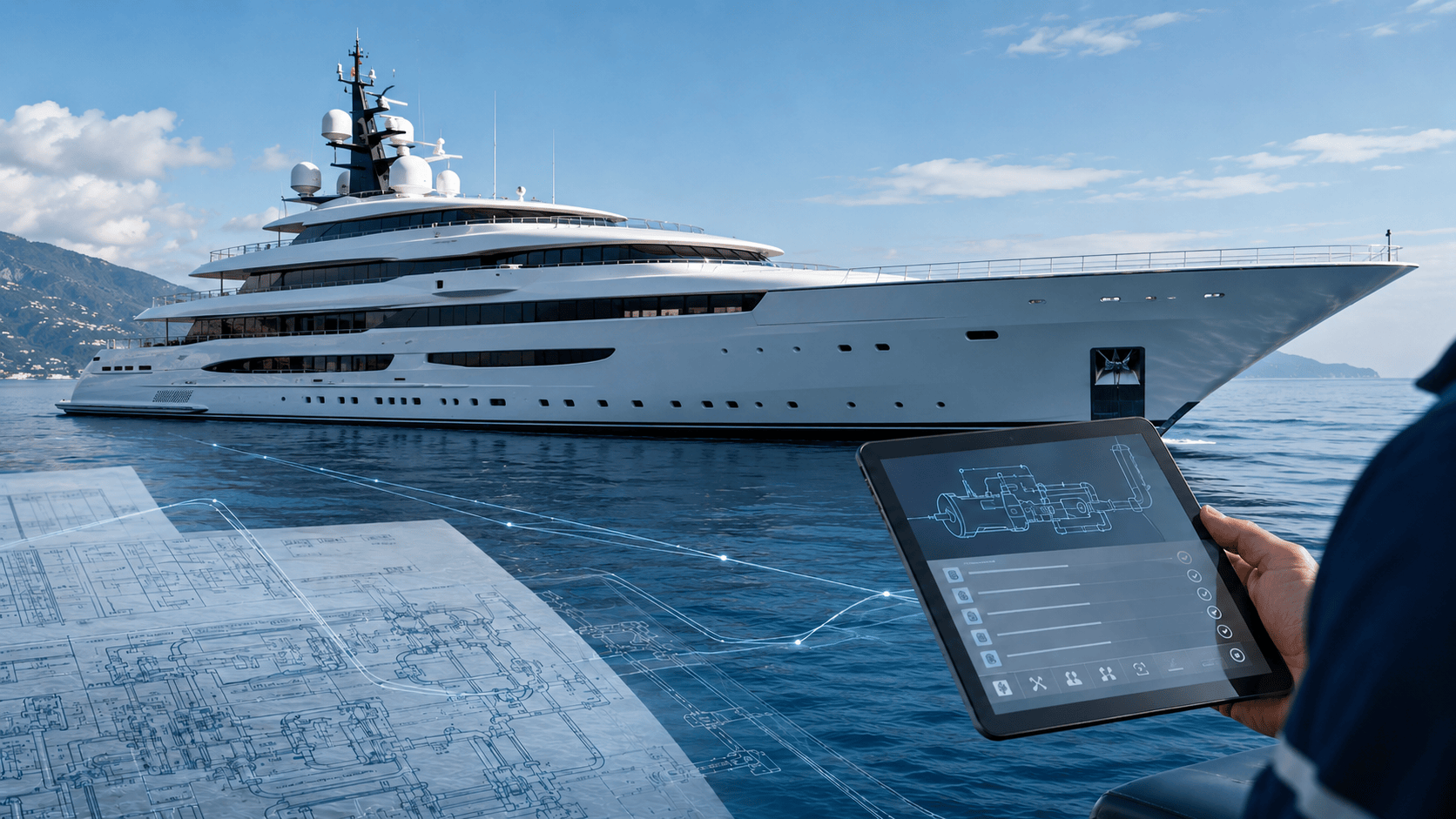
A yacht can be delivered with thousands of pages of documentation, detailed drawings, OEM manuals and technical data.
That does not automatically mean the people responsible for operating her have the information they need.
There is an important difference between information created to design, build and commission a yacht, and information created to help a crew operate it safely and confidently once she enters service.
Both are valuable. Both are necessary. But they serve very different purposes.
For captains, engineers, officers and shore based teams, the issue is not whether technical information exists. It is whether the right information can be found, understood and applied quickly when it matters.
That is the difference between shipyard information and operator information.
Information can be technically complete but still difficult to use
Shipyard documentation is typically produced to support the design, construction, commissioning and delivery of a vessel.
It may include as built drawings, equipment schedules, commissioning records, schematics, vendor manuals and system data. This material is essential during a project, particularly for engineers, subcontractors, commissioning teams and warranty departments.
However, once a yacht is in operation, the crew’s requirements change.
They are not trying to understand every design decision made during the build. They need to know how a system works onboard this particular vessel, what the safe operating sequence is, where key components are located, what the hazards are and what to do when something is not working as expected.
A drawing can show every component in a system. That does not always explain what needs to happen before starting it, which valves must be isolated, what alarms should be expected or what could go wrong if the sequence is not followed correctly.
The information may be correct. It may simply not be structured for the person who needs to use it at sea.
Builders and operators ask different questions
A shipyard team may need information to answer questions such as:
- Has the system been installed in accordance with the design?
- Does it meet the required specification?
- Has it been tested and commissioned?
- Which contractor is responsible for a particular component?
- Does the drawing reflect the final arrangement?
An operator asks different questions:
- How do I start, stop or isolate this system safely?
- What should I check before use?
- Where is the relevant equipment located?
- What are the warning signs that something is wrong?
- What should I do in an emergency?
- Who needs to know if the system is unavailable?
These questions are not less technical. They are simply more practical.
They are based on real onboard decision making, often during a busy handover, a maintenance task, a guest operation or an unexpected fault.
Operator information must reflect that reality.
The risks of relying only on builder style documentation
When onboard teams are left to work from large drawing packs, separate OEM manuals and fragmented files, they often have to spend valuable time assembling the answer themselves.
That can lead to inefficiency, uncertainty and inconsistent ways of working.
The issue becomes more significant when:
- A system has been modified during the build or refit
- Information has not been updated to reflect the final as built arrangement
- A crew member is new to the vessel
- A task is being completed outside normal routine
- Multiple manuals need to be checked before a decision can be made
- The team is under time pressure
In these situations, the challenge is not a lack of intelligence or technical competence. It is the difficulty of turning scattered information into a clear operational decision.
This can affect more than day to day efficiency.
It can create delays during troubleshooting, make maintenance planning harder, slow down familiarisation for new crew and create unnecessary uncertainty during warranty discussions. It can also increase the likelihood that crew rely on informal knowledge or verbal handovers rather than verified vessel specific information.
Over time, that creates a dependency on the people who know the yacht best.
When those people leave, the knowledge can leave with them.
Operator ready information is built around usability
Operational documentation should not be a simplified version of shipyard material. It should be a purpose built resource that translates technical detail into clear, vessel specific guidance.
A strong operator focused documentation suite should help crew understand not just what is installed, but how it should be used.
That means it should be:
Verified against the yacht as built
Documents need to reflect the vessel that was actually delivered, including changes made during construction, commissioning or refit.
A technically impressive drawing is of limited value if it does not match the equipment or arrangement onboard.
Structured around systems and operations
Crew should be able to find information by system, task or operating requirement, rather than searching through multiple folders and manuals.
The information should follow the way the yacht is run, not simply the way the project was designed.
Clear about actions, risks and responsibilities
Good operational content explains what needs to happen, in what order, what should be checked and where caution is required.
It should make clear where a procedure has operational, safety or maintenance implications.
Easy to access under real onboard conditions
Crew do not always have the time or space to unfold a large drawing, search through a dense manual or compare several supplier documents.
Clear system diagrams, practical quick reference material, digital access and concise vessel specific guidance can make information significantly more useful when it is needed quickly.
Maintained throughout the vessel’s life
A yacht does not stand still once she leaves the shipyard.
Systems are upgraded, equipment is replaced, layouts evolve and operational procedures develop. Documentation must be treated as a live operational asset, not a delivery requirement that is filed away and forgotten.

The value is not just in the documents
Operator ready information also supports a stronger safety culture.
When crew can access clear, verified guidance, they are better able to understand the systems they are responsible for and make informed decisions. It improves familiarisation, supports more focused training and reduces reliance on assumptions.
It also gives captains and management teams greater confidence that the vessel’s technical knowledge is not held only in the minds of a small number of experienced people.
This is particularly important on yachts with regular crew rotation, complex technical systems or demanding owner schedules.
A vessel should not become harder to operate safely simply because a key engineer, officer or captain has moved on.
Shipyard information and operator information should work together
This is not an argument against shipyard documentation.
Shipyard drawings, OEM manuals and commissioning information all have an important role to play. They are often the source material from which a detailed operational picture can be built.
The problem comes when they are treated as the finished operational solution.
A yacht needs more than a collection of information. It needs a usable, unified understanding of how its systems and operations work in practice.
That is where operator focused technical documentation adds value.
It bridges the gap between the information provided during design and build, and the information a crew needs to operate the vessel safely, efficiently and consistently.
From delivered documentation to operational confidence
A successful yacht handover should not be measured only by the number of manuals supplied or drawings included in the delivery file.
It should be measured by whether the people onboard can find the right information, understand it and act on it with confidence.
Technically complete does not always mean operationally useful.
The most effective documentation gives crews a practical, reliable source of knowledge that supports daily operation, familiarisation, maintenance, safety and long term continuity.
That is the standard vessels should be working towards: information created not just for the yacht that was built, but for the yacht that must be operated every day.
Leave a Reply