
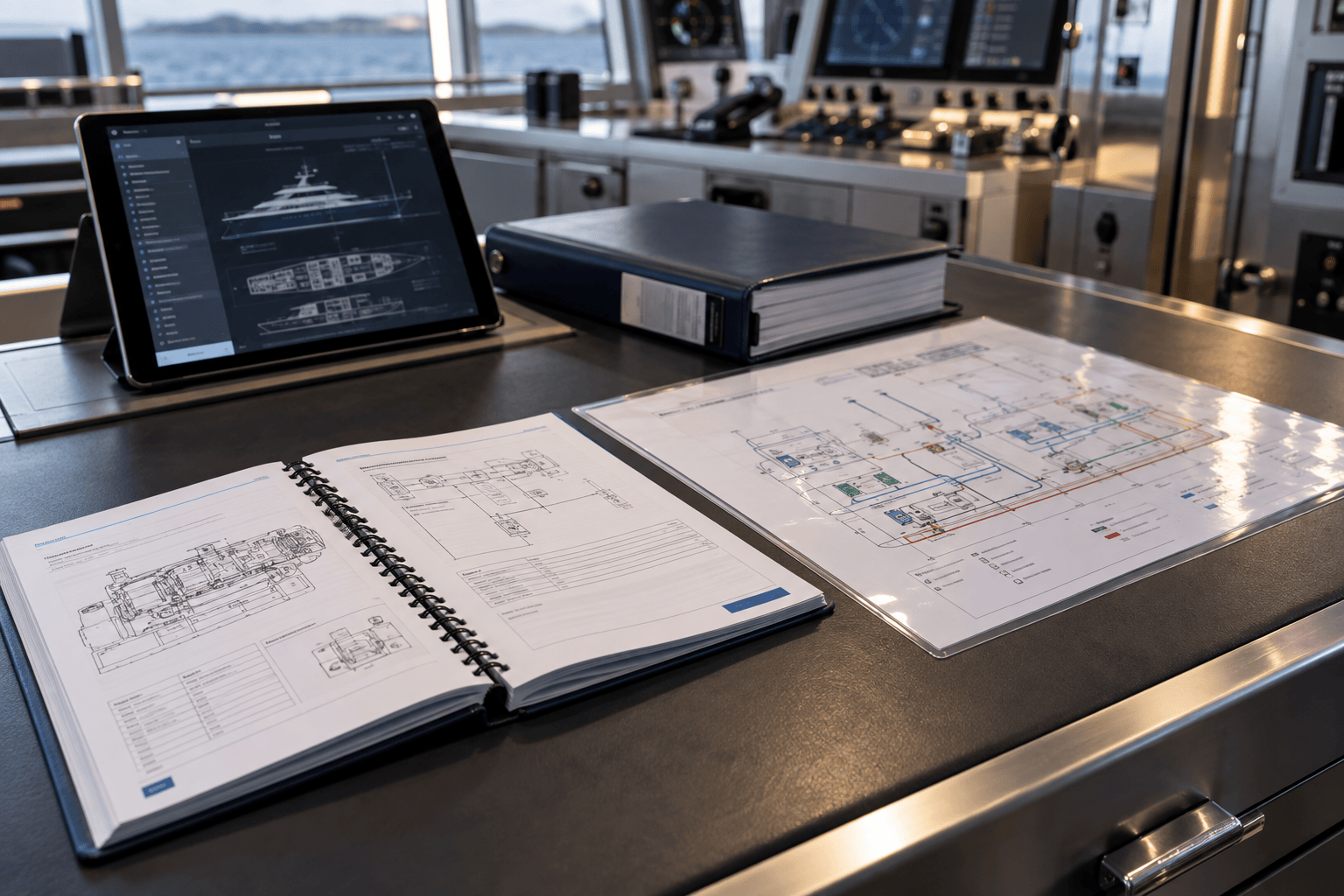
A yacht can have a complete set of manuals onboard and still leave crew searching for the right answer when it matters.
The information may exist in a technical operating manual, an OEM document library, a safety manual or a digital system. But during a busy watch, an equipment issue, a handover or an emergency response, the question is rarely whether the information exists.
The question is whether the crew can find, understand and apply it quickly.
That is why practical formats such as laminated drawings, pocketbooks and concise vessel specific references continue to have an important role in superyacht safety and operation.
They are not a replacement for formal manuals. They are what helps turn those manuals into information that can be used in the moment.
Stored somewhere is not the same as usable when needed
There is a common assumption that digital access alone solves the information problem onboard. A document stored on a shared drive, tablet or onboard server is certainly more accessible than a document that is missing altogether.
But accessibility is about more than storage location.
A crew member may need to identify an isolation point, understand the sequence of a system, confirm emergency equipment locations or check the operational relationship between connected components. In these moments, opening a large manual, navigating multiple folders or searching through dense technical text can be slower than the situation allows.
Useful vessel information is designed around retrieval.
It anticipates the questions crew are likely to ask and presents the answer in a way that is clear, relevant and easy to absorb. That may mean a simplified system drawing in the engine room, a compact pocketbook on the bridge, or a concise quick reference held where the task is carried out.
The format matters because it affects whether information is used.
Why physical references still have a place onboard
Modern yachts rely on increasingly sophisticated digital systems, and digital documentation brings clear advantages. It can be updated, searched, distributed and connected to wider onboard management systems.
However, a practical safety culture should not depend on one format alone.
Laminated drawings and pocketbooks offer several advantages in day to day operation:
They are available at the point of use
A drawing placed near the relevant equipment can support understanding without requiring the crew member to leave the area, locate a device or search through a document library.
This is particularly valuable for systems that are complex, rarely used or operated by more than one department.
They reduce unnecessary interpretation
Technical documentation can be detailed for good reason. Yet the level of detail needed for engineering, commissioning or warranty discussions is not always the level of detail needed by someone carrying out an operational task.
A well designed quick reference removes unnecessary information while retaining the essential operational context. It helps crew see the system, the key components and the actions that matter.
They support familiarisation and crew continuity
Crew turnover is part of yacht operation. New crew members need to build confidence in vessel specific systems quickly, while experienced crew need reliable references when dealing with equipment they may not use every day.
Pocketbooks and clear diagrams help create a common point of reference across the crew. They support familiarisation, reinforce formal training and reduce reliance on individual memory.
They work under pressure
When time is limited, information should not require effort to decode.
A concise, well structured reference can help a crew member move from uncertainty to action more quickly. It does not remove the need for training, experience or sound judgement. It supports them by making the right vessel information easier to retrieve.

The difference between complete information and operational information
Shipyard drawings, builder documentation and OEM manuals all have value. They may be technically detailed and important for construction, maintenance, warranty and specialist troubleshooting.
But they are not always designed around the needs of the people operating the vessel.
A builder may require a drawing to show every technical detail, routing path and installation element. An engineer or officer may instead need to understand the system flow, key isolation points, relevant alarms or operational dependencies.
Both requirements are valid. They are simply different.
This is where operator focused documentation becomes essential. It takes verified vessel information and structures it around how the yacht is actually run.
The result is not less information. It is better organised information.
Laminated drawings and pocketbooks form part of this wider approach. They provide a practical layer between the full technical record and the immediate needs of the crew.
Better access supports better safety decisions
Safety is strengthened when crew know where to find information, trust that it is current and understand how to use it.
That does not happen simply because a manual has been delivered.
It happens when vessel information is:
- Clear enough to understand quickly
- Specific to the yacht and its systems
- Available where and when it is needed
- Kept current as the vessel changes
- Supported by familiarisation and training
Quick access information formats support all of these principles. They make essential knowledge more visible in the everyday working environment of the yacht.
A concise drawing can prompt a useful conversation during familiarisation. A pocketbook can reinforce a safety procedure during a handover. A simple reference can help a crew member check their understanding before carrying out a task.
These small moments contribute to stronger operational confidence over time.
Digital and physical should work together
The choice should not be between traditional documentation and digital tools.
The strongest onboard information systems combine both.
Formal manuals provide depth, governance and a complete technical record. Digital platforms can make documentation searchable, updateable and easier to connect with familiarisation activity. Physical quick references provide immediate visibility and usability at the point of need.
Together, they create a more practical information environment onboard.
Sentini’s approach brings these elements together through formal technical documentation, operator focused supporting materials, laminated drawings, pocketbooks and familiarisation tools. The purpose is not simply to deliver documents. It is to help crews access and apply the vessel knowledge that supports safer, more confident operation.
Because information only adds value when it can be used.
And onboard, the most useful format is often the one that helps the crew find the right answer before time, pressure or uncertainty gets in the way.
Leave a Reply